

Outlook
Part of Before you set next year's local service marketing outlook, read this
When to refresh your local service marketing market outlook
A quarterly guide to refreshing your local service marketing market outlook in England, covering 2025 data rules, platform updates and the signals worth tracking.
What to take away
- The biggest recent change is legal. The Data (Use and Access) Act 2025 altered parts of the UK data rules on consent and cookies. Tracking arrangements made in earlier years need checking again.
- Value expectations have moved too. Ipsos tracks how households weigh price against worth through its Great Value Reset programme, which shapes what local buyers will pay.
- Ad platforms keep shipping changes. Google Ads logs updates on its own announcements page.
- Treat the outlook as a working document. Name your triggers, set review dates, and rebuild only when something real moves.
What changed in the last year
The largest shift for English service firms was legal, not creative. The Data (Use and Access) Act 2025 rewrote sections of the UK data protection framework, including provisions on cookies and consent. If your enquiry forms or call tracking were set up before that, test them again.
A rule change tells you what you may do, not what to sell. Local service marketing: trends and outlook sets out the demand and channel shifts around that legal change, which is the part that shapes revenue.
Platform movement is quicker. Google Ads product announcements are the record of bidding, reporting and format changes as they ship. A change to targeting or reporting can reset your cost per enquiry overnight.
Buyer behaviour moved as well. The Great Value Reset programme from Ipsos follows how consumers judge value against price. That matters when the households you serve are trimming optional spending.
Signals to watch each quarter
Each session should cover these signals:
- Enquiry volume by source.
- Close rate by channel.
- Cost per enquiry.
- Quote-to-job rate.
For a 90-minute quarterly review, spend 20 minutes on the checklist, 30 minutes on the two weakest channels, and 40 minutes deciding one change to test before the next quarter.
Watch your own numbers before you watch the market. If enquiries hold steady but close rates slide, the problem sits in pricing or follow-up, not demand. If both fall, look outward.
Compare each month with the same month a year earlier. Like-for-like readings are the only fair test.
Automation is shifting the cost base faster than most owners expect. Local service marketing AI applications in England explains where triage, quoting and follow-up tools fit, and where they simply add noise.
Quarterly review checklist
- Enquiry volume by source
- Share of quotes that become jobs
- Gap between quoted and invoiced work
- Compare month with same month last year
- Bring enquiry, quote and invoice logs
What to change in your planning cycle
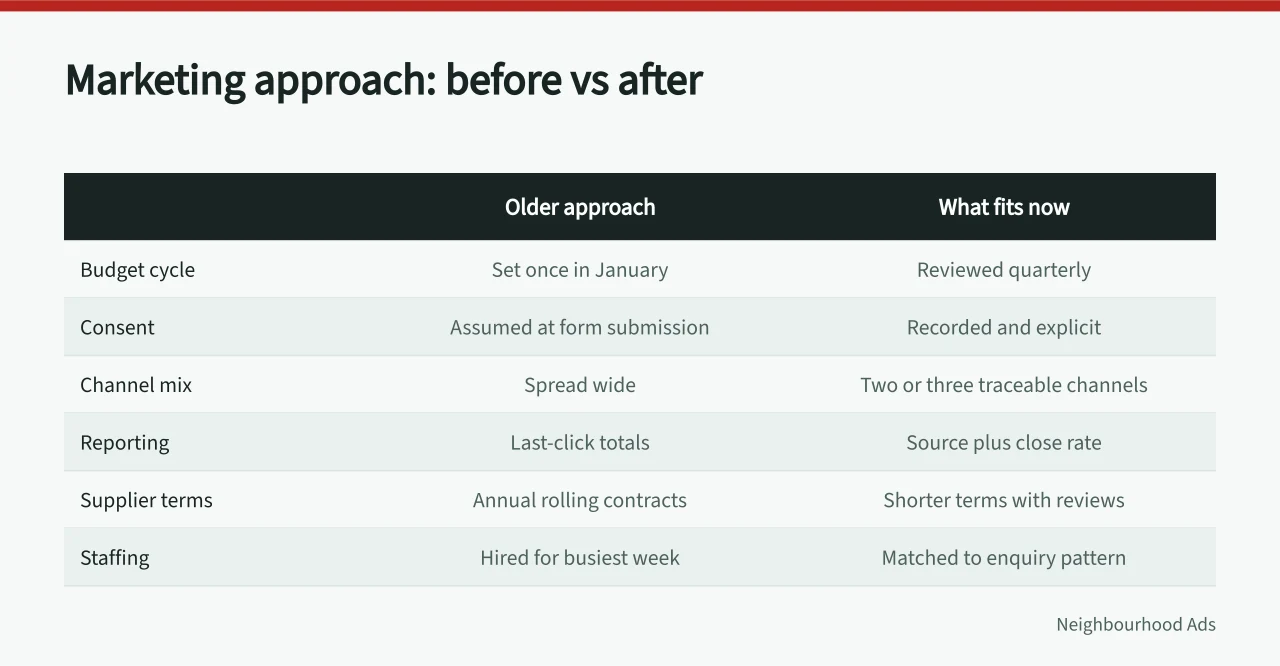
Older approach
- Budget cycle
- Set once in January
- Consent
- Assumed at form submission
- Value message
- Price-led discounting
- Channel mix
- Spread wide across many channels
- Reporting
- Last-click totals alone
- Supplier terms
- Annual rolling contracts
- Staffing
- Hired for the busiest week
What fits now
- Budget cycle
- Reviewed quarterly, with cost per enquiry tracked
- Consent
- Explicit, recorded and easy to withdraw, per the Data (Use and Access) Act 2025
- Value message
- Value-led proof, following the Ipsos Great Value Reset findings
- Channel mix
- Two or three channels with traceable enquiries
- Reporting
- Source plus close rate per channel
- Supplier terms
- Shorter terms with named review points
- Staffing
- Matched to the enquiry pattern by month
There is no single England-wide figure for cost per enquiry. It depends on your sector, service area, competition and form conversion. Use your own log: divide ad spend by enquiries. For an English service firm, if you spend £600 and get 20 enquiries, your cost per enquiry is £30. That figure is your benchmark, not a market average.
Update triggers to write down
A trigger is a fact plus an action. Write them as sentences, not themes.
- A consent or cookie rule change that touches your forms or call recording.
- A platform update that alters targeting or reporting.
- A close rate that falls for two full months.
- A rival competing on price in your service area.
- A supplier cost rise above a level you set in advance.
Review the list at every session and retire any trigger that no longer applies. A short list you act on beats a long one you file.
Common questions
How often should a local service business refresh its market outlook?
Quarterly, with a short monthly look at enquiry numbers. The annual plan should hold assumptions you test, not conclusions you file.
Which signal deserves the most attention?
Close rate by channel. It tells you whether demand is real or whether your pricing and follow-up are leaking jobs.
Does the Data (Use and Access) Act 2025 change how I collect enquiries?
It updates parts of the UK data framework, including cookie and consent provisions. The Information Commissioner's Office (ICO) enforces it. Read the Act itself, then check your forms, tracking and retention against it.
Should I wait for platform changes before committing budget?
No. Build the plan so that one update cannot break it, then review when the announcements feed changes something you rely on.