

Operations
Part of Three ownership rules for running scale-ready local service marketing operations
4 written promises every local service firm should measure
How England's small local-service firms can write service standards: what to promise, who owns each promise, and how to check delivery from the enquiry log.
What to take away
- A plumber in Leeds promises a same-day callout. The office cannot tell which jobs qualify, and the customer hears a different story from each person who answers.
- Standards cover what you promise, how fast you respond, who owns the promise and what happens when it slips.
- Write them as numbers, not adjectives. "Answer within two rings" beats "friendly service".
- Review quarterly against the enquiry log. A promise nobody measures cannot be kept.
- The Business population estimates 2019 page is historical. Use the latest Department for Business and Trade edition for current figures; most UK businesses are small.
What service standards actually cover
The promises customers can test
A customer cannot audit your training or van stock. They can test whether the phone was answered and whether the quote arrived when you said.
Four moments that generate complaints
- First contactanswer the phone
- Quotingquote arrives when promised
- Attendancearrive in the window
- Aftercarefollow up after the job
- Each promise fixed in plain numbers
Start with first contact, quoting, attendance and aftercare. Write each promise in numbers.
For example, a two-van electrical firm in Norwich paying about £600 a month for local lead generation might set a 30-minute response window on web enquiries. That number changes the office rota, so it belongs in the standards document.
A heating firm in Bristol promises a one-hour callback on emergency jobs. On a Monday, a burst pipe enquiry at 08:10 gets a reply at 10:25. The owner rings the customer within 30 minutes of the miss and logs the cause.
Internal standards behind the promise
Standards also govern the steps behind the public promise. Who checks the diary before a job is booked? Who covers the shared inbox on a Saturday?
Five to eight internal standards is enough. One named owner per public promise is enough. The written division of duties sits in our guide to local service marketing team roles in England.
Turning promises into written standards
Numbers, owners and escalation
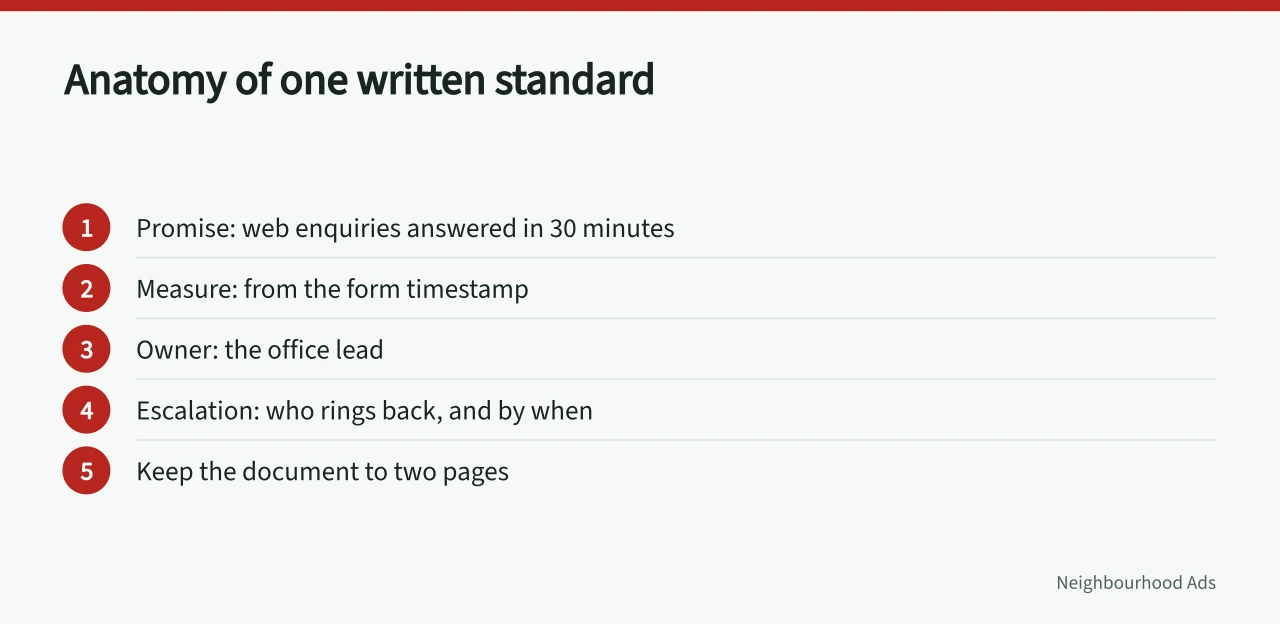
Write each standard with three parts: the promise, the measure and the owner. Example: "Web enquiries answered within 30 minutes in office hours, measured from the form timestamp, owned by the office lead."
Example standards document:
| Promise | Measure | Owner | Escalation |
|---|---|---|---|
| Answer web enquiries within 30 minutes in office hours | Form timestamp to first reply | Office lead | If over 30 minutes, office lead rings customer same day |
| Quote within 24 hours of site visit | Diary date to quote sent | Estimator | If over 24 hours, estimator sends holding email and new date |
| Call ahead 30 minutes before arrival | Job time minus call time | Engineer | If late, office rings customer with new arrival window |
Where standards meet marketing claims
Your website, Google Business Profile and paid ads repeat your promises. When standards change, they must change too.
When an agency runs the profile, Google's guidance on transferring primary ownership of a Business Profile sets out the steps. The standards document covers that handover.
For digital spend planned alongside these promises, the SME Toolkit from IAB UK is a reasonable starting point.
Checking delivery without guesswork
A simple monthly review
Once a month, pull the enquiry log. How many enquiries arrived? How many met the response standard? Where did the misses cluster?
Do not rely on memory or the loudest customer. The log is the evidence. If you have no log, write the standard that creates it.
| Date | Source | Job type | First reply | Meets standard? | Owner | Miss reason |
|---|---|---|---|---|---|---|
Worked example: 120 enquiries in March, 96 met the 30-minute standard, so 24 missed. If 15 misses fell on Mondays, fix Monday cover first.
The wider workflow sits in the local service marketing operations and delivery guide.
Changing a standard properly
Set a quarterly review date and change one thing at a time. When a promise changes, update the website, profile, quote template and supplier briefing in the same week.
Common questions
Do small firms really need written standards?
Yes, if more than one person speaks to customers.
How many standards should we start with?
Four customer-facing and three internal. Cover first contact, quoting, attendance and aftercare.
What happens when we miss a standard?
Someone contacts the customer within an agreed window and logs the miss for the monthly review.
Should standards appear in our adverts?
Only the ones you can measure. A response-time promise is safe if the log proves it.